16adda8c47
- Changed references in markup.md to update "data.html" to "data/" for clarity.
- Updated metadata.md to correct the link to the general documentation.
- Modified navbar.md to ensure stub values match the new permalink structure.
- Adjusted tables.md to reflect the new permalink for the table visualization page.
- Updated about.md to change the permalink from "/about.html" to "/about/" and revised content for clarity and impact.
- Changed browse.md permalink from "/browse.html" to "/browse/" for consistency.
- Added copyright.md page with copyright information and terms of use.
- Updated data.md to change permalink from "/data.html" to "/data/" and added introductory content.
- Created donate.md page to facilitate donations and acknowledge supporters.
- Updated locations.md permalink from "/locations.html" to "/locations/" for consistency.
- Changed map.md permalink from "/map.html" to "/map/" for uniformity.
- Added erasure.md page discussing the historical context of Black queer Kansas Citians.
- Updated out-there.md to correct the link to Lea Hopkins' interview.
- Changed subjects.md permalink from "/subjects.html" to "/subjects/" for consistency.
- Updated timeline.md permalink from "/timeline.html" to "/timeline/" for uniformity.
26 KiB
title, layout, permalink, credits, about-featured-image, position, heading, sub-heading, padding
| title | layout | permalink | credits | about-featured-image | position | heading | sub-heading | padding |
|---|---|---|---|---|---|---|---|---|
| Out There | about | /read/out-there.html | false | 6em |
Kansas City’s “Out There”: The 90’s Gay & Lesbian Variety Show Featuring Lea Hopkins
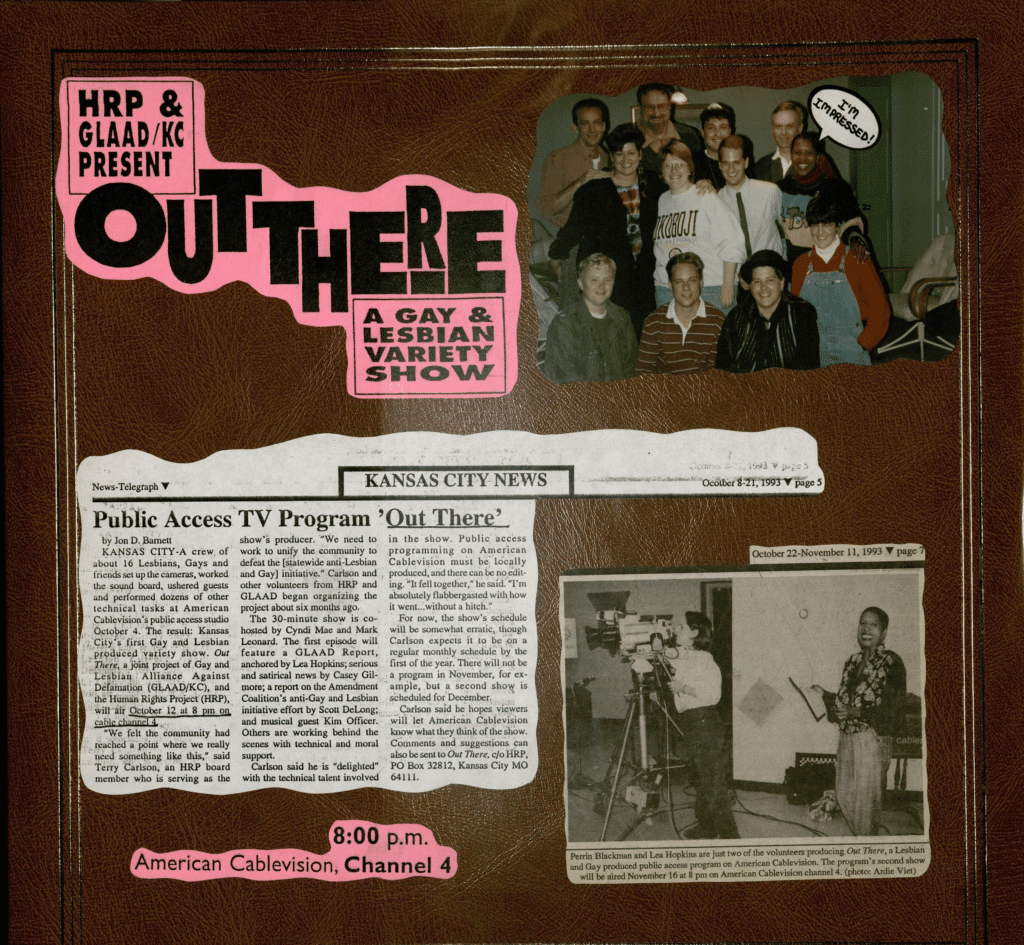
In 1993, a group of 16 people came together to launch Kansas City’s first-ever Gay and Lesbian Variety Show on American Cablevision in light of statewide, anti-queer legislation.
From Volume_1 of {B/qKC}: Nasir Anthony Montalvo's 2022 liberatory research into Kansas City's institutional archives, namely the Gay and Lesbian Archives of Mid-America (GLAMA).
BY NASIR MONTALVO ● ORIGINALLY PUBLISHED IN THE KANSAS CITY DEFENDER ON DECEMBER 08, 2022
All of us have cared about being represented at one time or another. We remember the first times we've seen ourselves on tv, heard ourselves on the radio, and tasted our cultures outside of our homes; and maybe you've never experienced these before, and long for the day some entity will adequately capture your essence for the world to see.
You may have heard (or said) this before: that you cannot aspire to be what you cannot see. That despite our imaginations, there are distinctions that lie between dreams and reality.
But there's more to it than that.
Before the concepts of visibility and representation were topics of public conversation, someone dreamed of performing–dreamed of a stage with a cast, all in front of a person and a camera. Some of that dreaming has, undoubtedly, led to the creation of these industries that so many historically oppressed groups are still battling to break into today.
If white men can dream of harm and enact it in real-time; can't we dream? Especially of something better?
Movies are one of the most readily drawn upon examples of representation. GLAAD's 2021 Studio Responsibility Index–a report on LGBTQ+ diversity across major motion picture films–shows that, though, there is growth across various categories of queer representation, the overall numbers still do not adequately capture the full spectrum of LGBTQ+ community.
Only 22.8% of films from 2020 featured queer characters–and of these characters, 55% were white, and majorly gay men. 0% of films featured a transgender or non-binary character, and this number has remained consistent for three years–only being broken by Benderdict Cumberbatch's controversial portrayal of a character named "All" in Zoolander 2.
Representation means more than solely being a featured character. This character has to be written well, paid adequately, portrayed by someone who actually holds these identities, and bring real, untold stories to the main stage. And when the film industry doesn't even so much as look like you, it becomes even harder to begin to tackle all these various components.
In the 90's, a group of Kansas Citians challenged representation with "Out There," a public access program on American Cablevision that featured queer people unfiltered. The group was known as the Human Rights Project (formerly known as the Human Rights Ordinance Project; not to be confused with the national organization)–and aimed to make voices heard amidst ongoing battle with queer civil rights legislation.
Pre-show: The fight for gay and lesbian civil rights protections

The birth of "Out There" was preceded by the infamous debacle over Ordinance 65430, also known as the Berkley-Shields Ordinance and, more commonly, the "Gay Rights Ordinance."
Introduced on April 12th 1990, Ordinance 65430 was proposed to provide civil rights protections on the basis of sexual orientation ([HROP Miscellaneous], 1990). Along with this was classifying HIV/AIDS as a disability, thus recognizing those with the disease as a protected category. With the rise in fear-mongering, hate crimes, and lack of state-sanctioned actions in concern with the AIDS pandemic during this time, tensions were heightened and this bill can be classified as one of Kansas City's most controversial pieces in legislative history.
Ordinance 65430 was drafted through the collaboration of the Human Rights Ordinance Project (HROP), a subgroup of ACT-UP Kansas City, and Katheryn Shields, a Kansas City Council member. On the day of the Ordinance's proposal, Mayor Richard L. Berkley signed as a co-sponsor of the ordinance–hence, Berkley-Shields (Barnett, 1990).


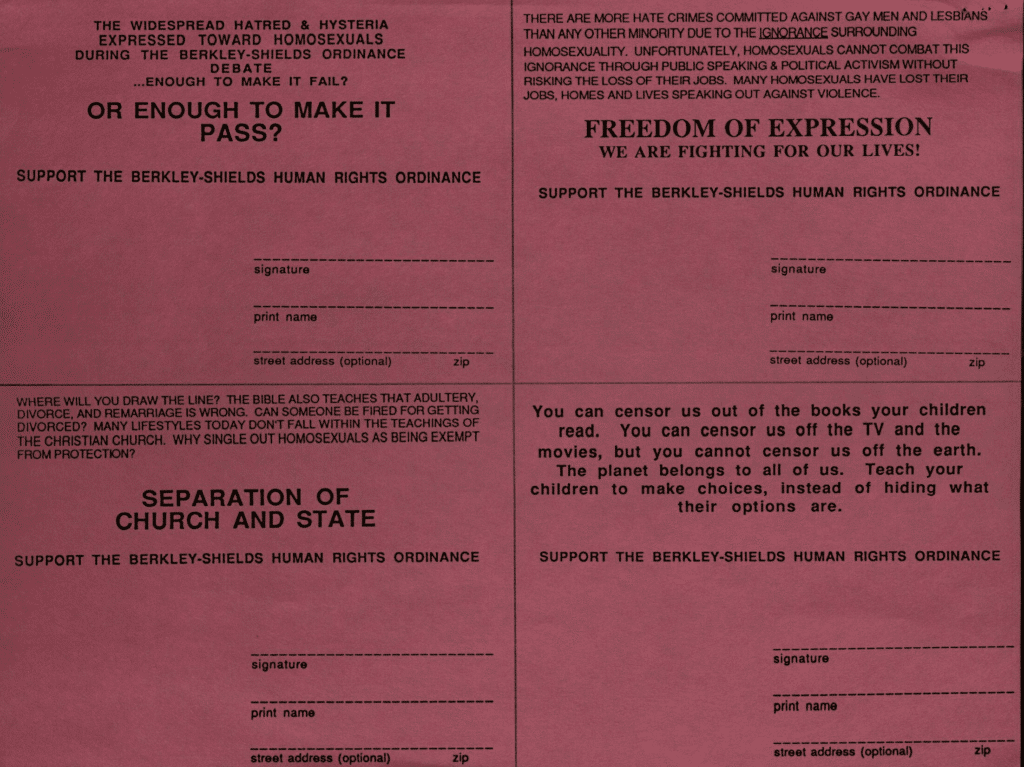
But the powerhouses behind Ordinance 65430 were mainly HROP–who committed to several actions in pushing the ordinance ahead through tactics like rallies, phone-banks, newsletters, and more. More can be learned about Ordinance 65430 through "The Ordinance Project," a film created by Dr, Austin Randall Williams.
Commercial Break: "Cleaver and the Klan go hand-in-hand," addressing anti-Blackness in Kansas City's Gay and Lesbian Community
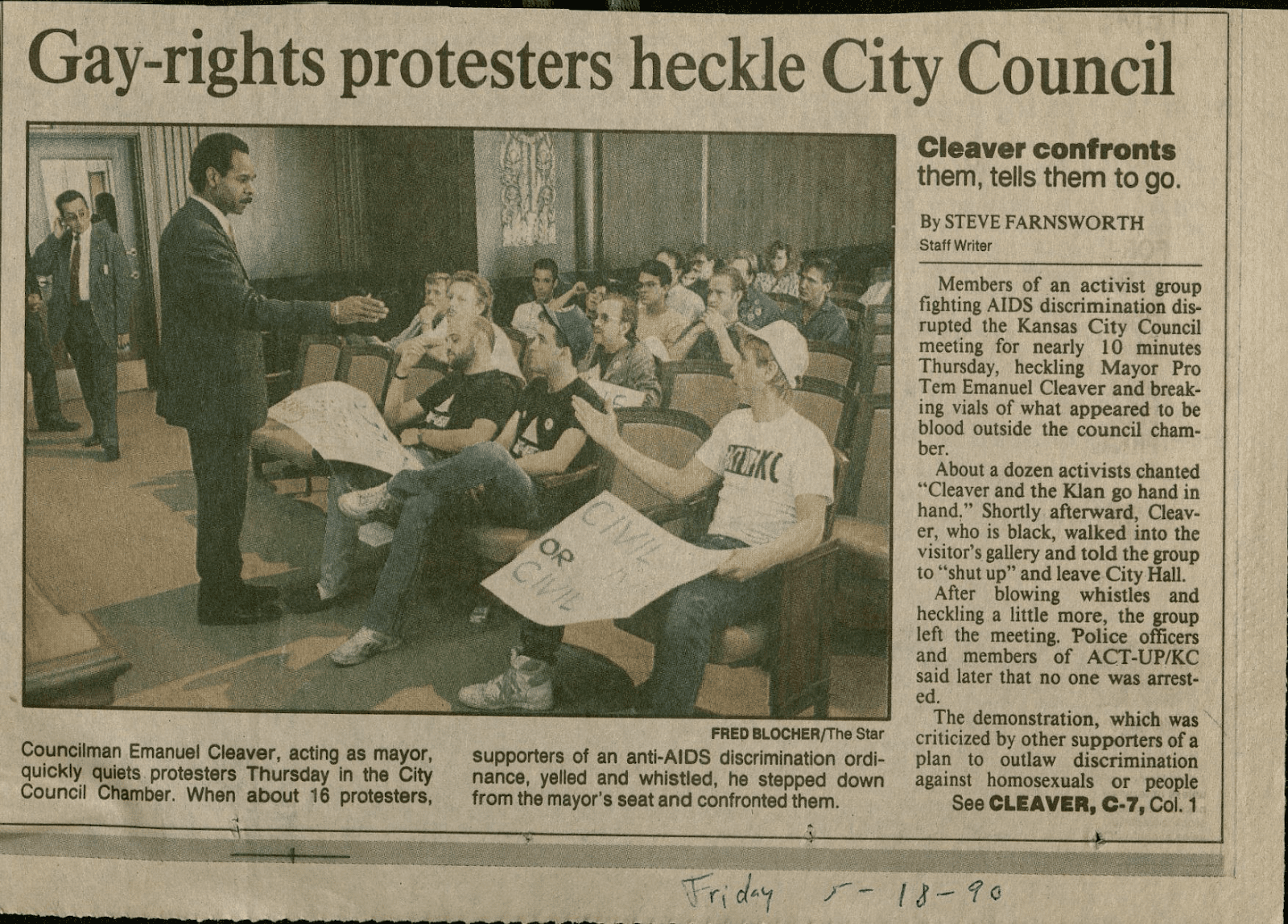
During HROP's organizing efforts, Emmanuel Cleaver quickly became a key figure in Ordinance 65430. Cleaver had 'shaky stances' as described by HROP members during the Ordinance's move through legislature (Williams, 2018). With Cleaver being a Baptist and heavily involved in our local St. James United Methodist Church, it's not surprising that people found his position on the Ordinance frustrating and unclear–namely on May 10, 1990 when he voted to send Ordinance 65430 back to Committee after it was brought up for an official vote to the City Council.
During a frustration-fueled demonstration on May 17, 1990, a few HROP members began chanting, "Cleaver and the Klan go hand-in-hand!," a direct assault on Cleaver's Blackness. Cleaver, in an interview with Austin Randall Williams for GLAMA's Oral History Project, also addressed some of the racist comments made by white gay activists during their organizing efforts:
"Where I became angry was the barrage of phone calls. Many of those phone calls were extremely nasty, some of them racially nasty. I came in already sensitive to the issue, but there were other things that I did not understand. And those things are this: That people don't go to the folk who are opposed to them. They always come and exercise that highest level of hostility toward the people who are already supportive."

HROP would also tell its members to be "BRIEF AND POLITE" in a 1990 phone banking campaign to City Council and the Mayor's Office, implying that Cleaver's sentiments were true and that this was an ongoing issue.
Ultimately, Cleaver would end up voting for sexual orientation to be recognized as a protected category (Ordinance 903612) on June 3, 1993 after the tumultuous fight. Cleaver would also be the first Mayor to attend GALA's 1991 Gay and Lesbian Pride Picnic, and also form a Commission on Lesbian and Gay Concerns in the same year.
I bring this information up not to defend Cleaver (nor any politician, for that matter) for inaction in the face of queer struggle. But I want to name this anti-Black action from gay activists, especially because various activists who were interviewed in 2018 about this continued to defend the use of the chant. The fight for civil rights protections while dually being racist and erasing Black, Queer people is illogical.
On-Air: Kansas City Alive presents...."Out There"


After the victory of Ordinance 903612, HROP dropped the O from its name and began calling itself the Human Rights Project (HRP) in order to pursue initiatives beyond the Ordinance. In a typed statement made by Kay Madden (HRP's acting legal aid) on November 3, 1993, she warns of a group named The Amendment Coalition and their plans to change the Missouri Constitution:
"The Amendment Coalition, the group spearheading the drive to pass a Colorado-type restraint on Missouri's power to pass laws to protect persons from discrimination based on sexual orientation, has gotten approval for the following language to appear on its petitions:
'Shall the Constituion of Missouri be amended by adding a new Article which would prohibit the state of Missouri, through any of its branches, departments or agencies, and its political subdivisions, including counties, municipalities and school districts, form enacting, adopting or enforcing any statute, order, regulation, rule, ordinance, resolution or policy whereby homosexual, lesbian or bi-sexual activity, conduct or orientation entitle any person or class of persons to have or demand any minority status, protected status, quota preference, affirmative action or claim of discrimination?"
If the Coalition secures the necessary 130,000 signatures [...] then the proposed amendment will appear on a state-wide ballot in November 1994."
Kay Madden, Nov. 3, 1993
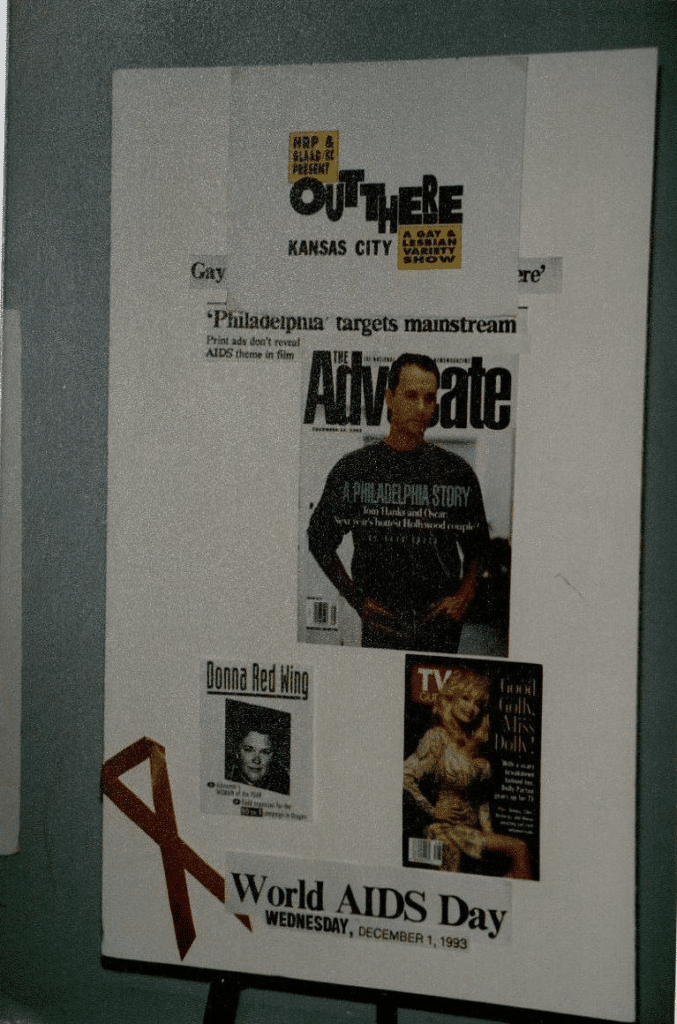
With the Amendment Coalition threatening to undo the work HRP had accomplished in Kansas City, HRP decided to make themselves as visible as possible.
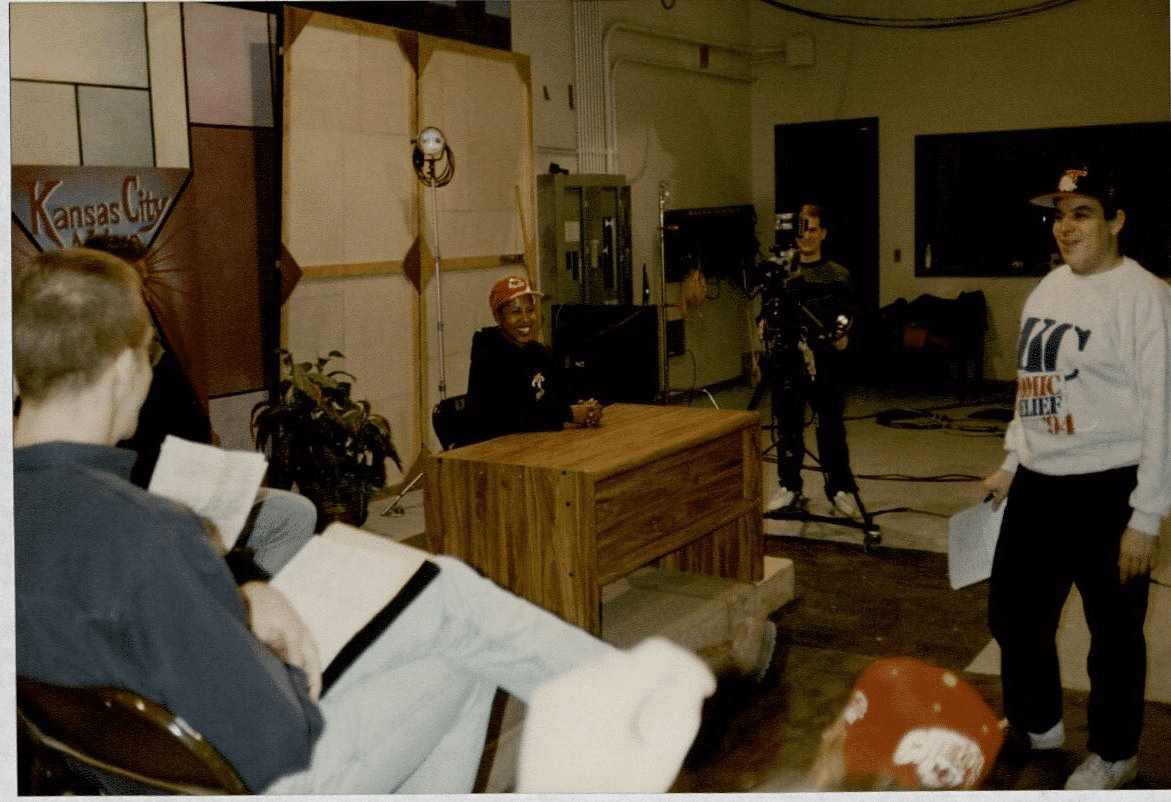
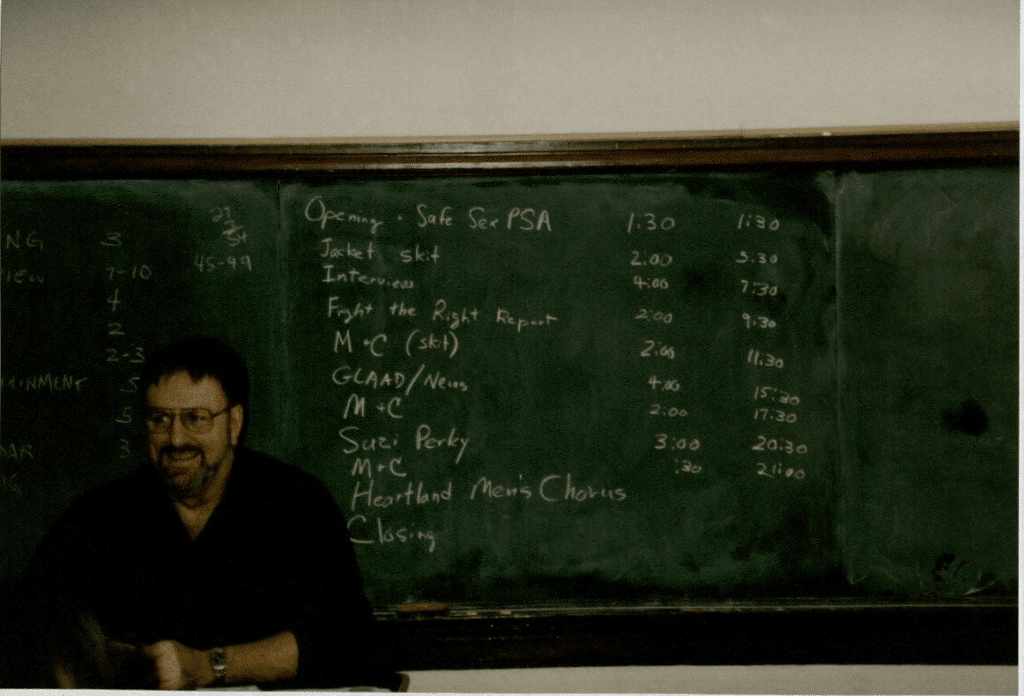
Commissioned by GLAAD and the Human Rights Project, Kansas City launched its first Gay and Lesbian produced variety show in October 1993. The show aired on American Cablevision's public, local access channel "Kansas City Alive"–whose goal was to hone in on events and issues affecting the Kansas City area at the time. (Williams-Lindsey, n.d.)
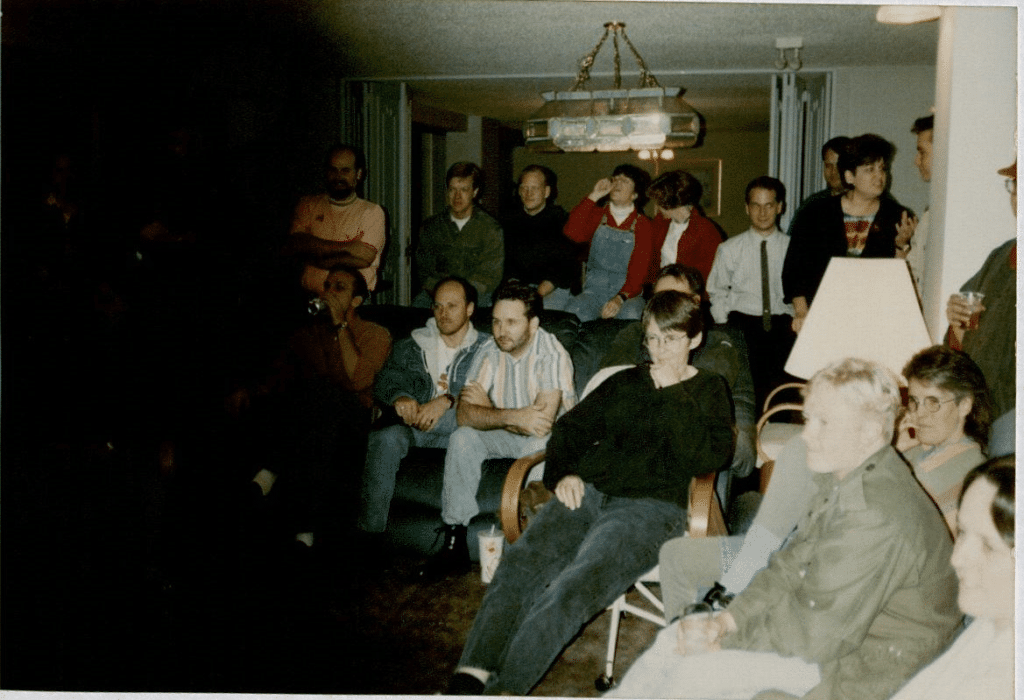
Made up of 16 crewmembers, the show was expected to run on a monthly schedule. According to HRP Board Member and show producer, Terry Carlson, the show was in-part created to "unify the community to defeat the [statewide anti-Lesbian and Gay] initiative."
The 30-minute variety show, as its moniker implies, featured various segments consisting of news reports, musical guests and various other entertainment, and even featured household name Lea Hopkins as a reporter for GLAAD [more on Lea later in this piece]. In their first episode, HRP Member Scott DeLong would call out The Amendment Coalition's actions in a segment as well.
The first episode aired on Oct 12th, 1993 at 8pm on cable channel 4/KCCP-TV. Archival records seem to indicate that the show ran for about 7 or 8 episodes before it ultimately closed out.
According to a July 11, 1994 article by AP News, however, the Amendment Coalition would fail to garner the signatures needed to appear on the Missouri ballot–proving HRP victorious once again.

Commercial Break: Lea Hopkins

Lea Hopkins has been an instrumental Black, Lesbian organizer in Kansas City for decades. Hopkins was behind the first Gay Pride Parade in Kansas City in 1979, and 43 years later was a Grand Marshall for Kansas City's Pride Alliance Parade earlier this year. Because of her work, she has undoubtedly pushed acceptance for Black Queer people to once unthinkable heights in the Midwest. Hopkins' role on Out There was to serve as a spokesperson for GLAAD, presumably because of her extensive involvement with the organization.
Listen to Lea Hopkins' interview with Austin R. Williams, as part of GLAMA's Oral History project, as she discusses her early days, moving to New York and becoming involved with Christopher Street, and organizing the first Gay Pride Parade in Kansas City.
After-show: where do we go from here?
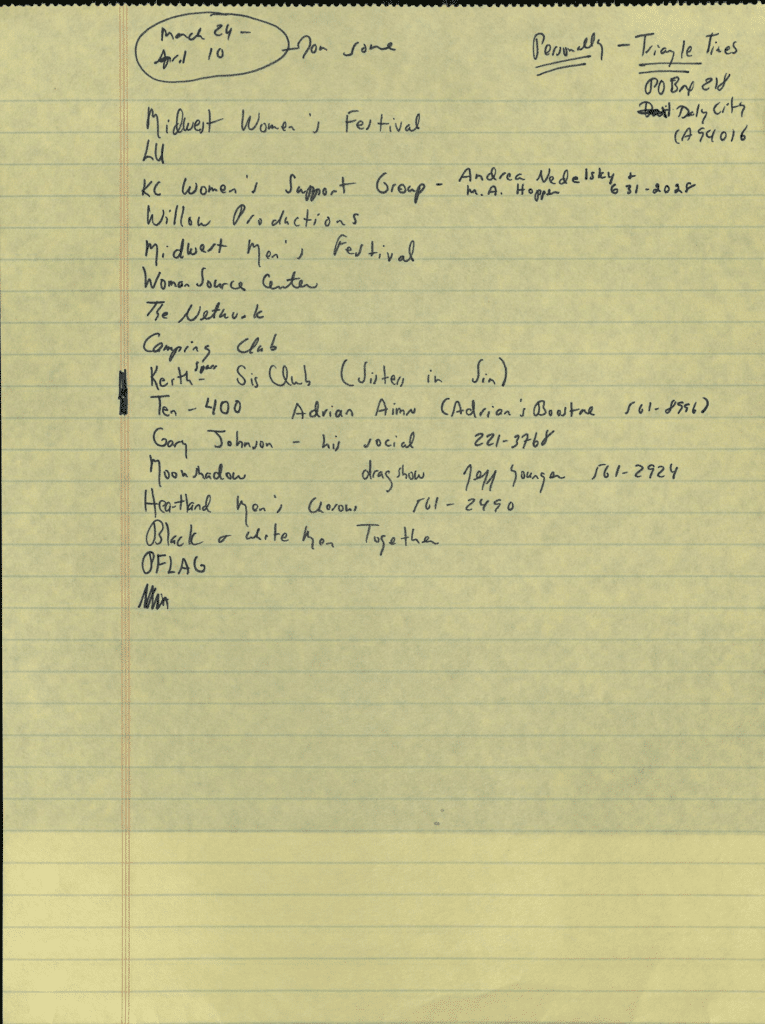

A big question you have is probably, "Where are the tapes?" I have the same question.
A quick search of American Cablevision on YouTube and Google will garner various videos from the 90's. Because of the state of HIV/AIDS and queer rights in Kansas City at the time, I can only assume those affiliated with American Cablevision did not take dutiful care to preserve this monumental program.
Circling back to representation, it's never as simple as wanting to "see people who look like you." For HRP in the 90's, being hyper-visible was a tool used to fight for basic human rights. And then having to continue fighting so these rights weren't taken away.
We often forget that at one point or another, remaining hidden was a means of creating safe spaces and protection. And that's not to say we should hide, but it is to say we need to continue challenging the systems that force us to hide behind the camera. Because Black Queer people are out there, and are ready to be seen.
Sources:
American Cablevision. (2022). 1990 American Cablevision Cable TV Provider Kansas City Commercial Jingle -- Coming Through for You [TV Commercial]. In CRT Afterglow (Ed.), YouTube. https://www.youtube.com/watch?v=gd8kiLcEjPg
GLAAD Media Institute. (2021). 2021 Studio Responsibility Index. In GLAAD. GLAAD. https://www.glaad.org/sri/2021
Hamilton, R. (Ed.). (2016, February 11). As Predicted, "Zoolander 2" Is Pretty Transphobic. Nylon. https://www.nylon.com/articles/zoolander-2-review-transphobic-controversy
[Hopkins' "Out There" Scrapbook]. (ca. 1993-1994). Lea Hopkins. Gay and Lesbian Archive of Mid-America, LaBudde Special Collections, Miller Nichols Library, Kansas City, MO, United States.
[HROP Flyers and Pamphlets]. (ca. 1989-1994). Kay Madden Collection (Box 1, Folder 15). Gay and Lesbian Archive of Mid-America, LaBudde Special Collections, Miller Nichols Library, Kansas City, MO, United States.
[HROP Handwritten Notes]. (ca. 1989-1994). Kay Madden Collection (Box 1, Folder 17). Gay and Lesbian Archive of Mid-America, LaBudde Special Collections, Miller Nichols Library, Kansas City, MO, United States.
[HROP Miscellaneous]. (ca. 1989-1994). Kay Madden Collection (Box 1, Folder 18). Gay and Lesbian Archive of Mid-America, LaBudde Special Collections, Miller Nichols Library, Kansas City, MO, United States.
Jackson, D. W. (2016). Changing Times: Almanac and Digest of Kansas City's LGBTQIA History (50th Anniversary Commemorative Edition, pp. 115--116). The Orderly Pack Rat.
Kansas City Pride Alliance [@kcpridealliance]. (2022, October 14).
Introducing: Lea Hopkins If you haven't followed us on TikTok you should! @kcpridealliance. Retrieved from https://www.instagram.com/reel/CjsbDmpDkrV/?utm_source=ig_web_copy_link
Mills, K. (Ed.). (1994, July 11). Few Anti-Gay Measures Will Appear on State Ballots in Fall. The Associated Press. https://apnews.com/article/3f146eac71eb172294ae6073eda349ee
Williams, A.R. (2021). THE ORDINANCE PROJECT: COMMEMORATING KANSAS CITY'S LGBTQ LANDMARK LEGISLATION [Doctorate Dissertation]. https://mospace.umsystem.edu/xmlui/bitstream/handle/10355/89576/Williams_umkc_0134D_11812.pdf?sequence=1
Williams, A.R. (2018). The Ordinance Project [Website Video]. In Gay and Lesbian Archives of Mid-America (GLAMA). https://libweb.umkc.edu/glama/ordinance-project
Williams, A. R. (2018, December 10). Jon D. Barnett. Profiles in Kansas City Activism. Retrieved June 10, 2022, from https://info.umkc.edu/kcactivism/?page_id=40
Williams-Lindsey, T.C.. (n.d.). Home [LinkedIn page]. LinkedIn. Retrieved December 8, 2022, from https://www.linkedin.com/in/tracywilliamslindsey/